MECO - A worldwide leader in water purification


Reverse Osmosis

Forward Thinking Solutions for Reverse Osmosis.

MECO developed Reverse Osmosis plants in the early 1970s, when the technology first became commercially viable. Since that time, we have garnered tremendous experience in a variety of industries. In the biopharm industry, RO quality water is used as feed for distillation, steam generators and EDI units.


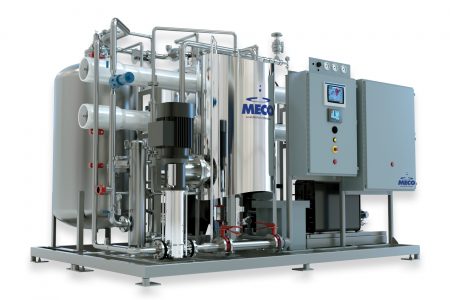
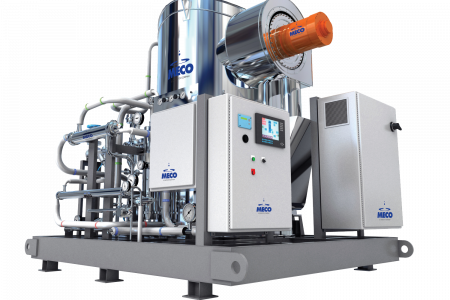
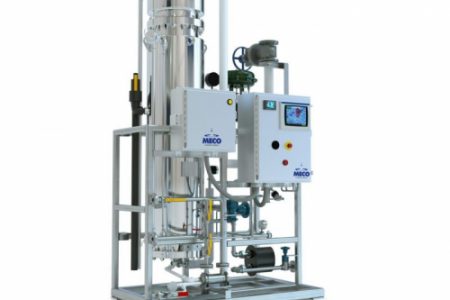
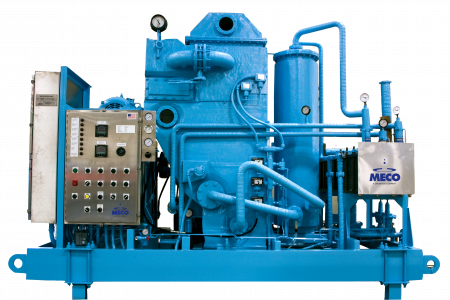
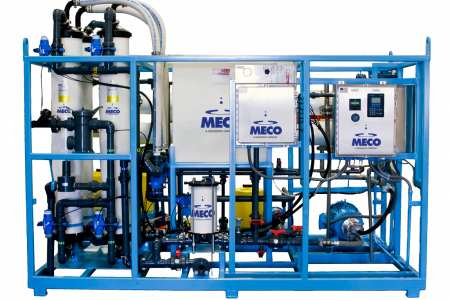
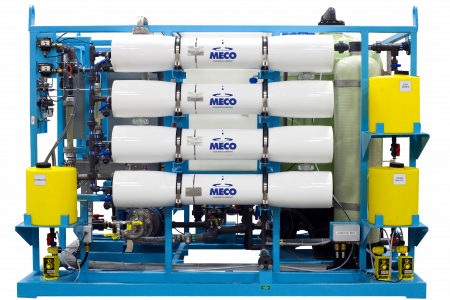
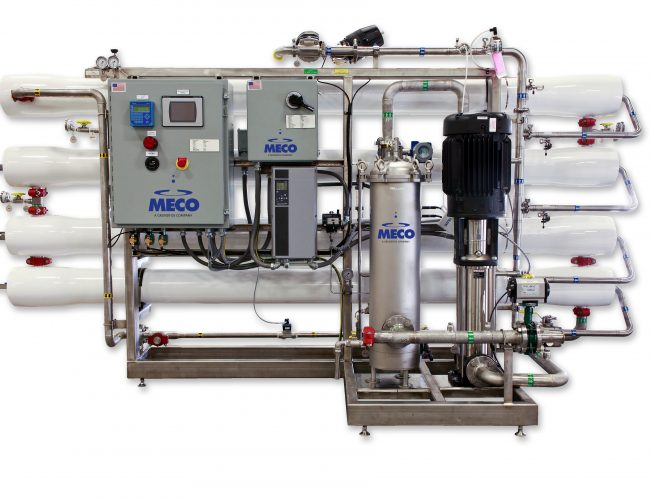
MECO RO units incorporate all of the components and instrumentation required for operation, as well as the versatility to adapt to specific customer requirements. Technical parameters such as cross flowrates and membrane flux are among the most conservative in the industry. When membrane fouling does occur, or there is a need for routine maintenance, you will find MECO's MASTERsupport™ service capabilities to be the most comprehensive in the industry. MECO RO units are also available in the MASTERpak™ series, a system that incorporates Pretreatment, RO, and EDI all on a single packaged skid.

Side Entry

Side entry piping on RO pressure vessels allows for easier cleaning and removal of membranes when the need arises. click here to enlarge.


Sample Ports

Productwater sample ports facilitate troubleshooting and allow probing of pressure vessels to isolate membrane problems. click here to enlarge.


Cross Flow

  • Cross flow exceeds manufacturers recommended [25 - 32 GPM/pressure vessels]
  • Conservative fluxes of 12 - 16 GPD

The Reverse Osmosis Process

Two solutions made up of a solvent (water) and a solute (salt) with different concentrations have a tendency to equalize their concentrations when separated by a semi-permeable membrane. The water will tend to flow across the membrane to the more concentrated solution. This phenomenon is termed osmosis. If an external pressure is applied to the solution of higher concentration, the solvent will be separated from the solute and flow across the membrane via reverse osmosis.

MECO MASTERedge™ Membranes

Spiral wound membrane elements are the primary configuration used today in water treatment applications. Two layers of the semi-permeable membrane are glued on three sides to create an envelope around a porous permeate collector fabric. The open end of several envelopes are glued to a perforated permeate tube in a configuration that allows permeate in the permeate collector fabric to flow into the tube.

These envelopes, with a layer of plastic netting between each to maintain the feed stream spacing, are wrapped around the tube in a spiral arrangement. The pressurized feed water flow enters at the end of the spiral and flows axially through the channels created by the plastic netting. Some of the feed water passes through the membrane while the majority of the dissolved solids are rejected, that is, not able to pass through. The purified water flows into the permeate collector fabric and flows along the spiral path into the permeate tube.

The concentration of dissolved solids increases as the feed flow progresses through the length of the element and exits the other end.

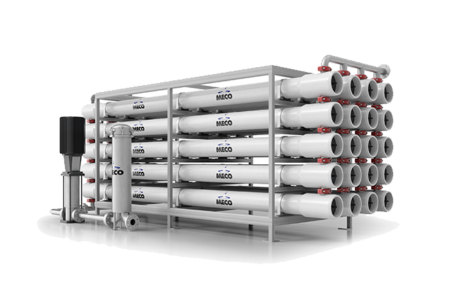
Multiple elements in series and/or parallel arrangements, called arrays, are utilized to meet the requirements of a particular system.

MECO MASTERedge™ Membrane Flux

The amount of membrane area employed for a given output determines a vitally important design element known as the flux rate. The flux rate is defined as the gallons per day of permeate which passes through one square foot of membrane area (GFD). A high flux rate translates to less membrane area and a lower capital cost. However, a higher flux rate results in increased fouling of the membrane and higher operating pressure. Hence, a higher cost of operation due to both energy and the maintenance associated with more frequent cleanings, and most likely shorter membrane life.


Flux (gfd) =         the daily permeate flow that passes through one square foot of membrane surface.


Flux (gfd) =            permeate output (gall/d)

                          —————————————————

                           No. elements X element area (sf)


MECO MASTERedge™ Membrane Cross Flow

The flow of the feed water stream across the membranes surface is called the cross flow. The lowest cross flow for each element occurs at the reject end of the element and the lowest cross flow for each series of elements occurs at the reject end of the last element. The cross flow design parameter is therefore the reject flow from the last element in each series. Higher reject flow provides higher cross flow.

Proper cross flow rates impart a shearing force and turbulence across the membrane surface aiding in the effort to reduce fouling and cleaning. Higher cross flow rates often result in a system having more pressure vessels, additional piping and a pump with a higher flowing rate, i.e. higher capital cost. The advantage, however, is reduced maintenance associated with less frequent cleanings and most likely improved membrane life.

Q: Can I make USP grade water from an RO unit?

A: No. Even with a two-pass RO unit, you will not consistently produce USP grade water. While it may be possible to produce USP grade water immediately after startup, the water quality will likely not meet the USP requirements as the membranes age. The use of Deionization bottles or Electro-deionization will be required after the RO to meet USP requirements.

Q: What kind of water quality can I expect out of an RO unit?

A: It is difficult to predict the permeate quality of an RO. RO product quality relies heavily on the quality of the feed water and the types of membranes used. The most effective tool that helps determine the permeate quality is an accurate water analysis. MECO can evaluate the water analysis and run RO projections to help determine the permeate quality of any RO design.

Q: What sanitization options are available for RO units?

A: Hot water sanitization and chemical sanitization are both used to sanitize RO units. Hot water sanitization has a much higher initial cost, as it requires more instrumentation, a heat exchanger, controls, and special membranes. The high heat (180F) can also reduce the life of the membrane if frequent sanitizatons are required.

Chemical sanitization has a much lower initial cost. Chemically sanitized units do not require stainless steel feed lines, special membranes, heat exchangers, controls, and added instrumentation. A CIP skid is required, but if a customer already has one for an existing piece of equipment, it can easily be adapted for use on the RO, as well. The drawback is that sanitization chemicals have to be purchased, handled, and disposed of every time the unit is sanitized.

Q: What kind of operational issues and maintenance should I expect to have?

A: RO units need a good bit of attention. The RO unit should be monitored on a daily basis and records should be kept on pressures, flowrates, and water quality. This helps determine when the RO unit is experiencing problems with scaling, biofouling, membrane degradation, etc. Since problems with RO units are usually not associated with catastrophic failures, having the ability to trend data makes diagnosing a problem much easier.

Even with proper care, RO membranes will have to be replaced. The average life of RO membranes is about 3 years. Replacement will require a full shutdown of the RO unit. Depending on the number of membranes in the system, this can be an expensive maintenance cost that should not be overlooked.

Membrane cleaning is a task that will have to be performed on a regular basis. Cleaning of the membranes is required for removal of scale and biofouling. Depending on the size of the RO unit, it should be noted that cleaning may be a very time consuming task and the RO unit must be shutdown.

Q: What are some important considerations for overall RO system design?

A: The first consideration you should make is what type of materials of construction do you need. PVC is an inexpensive material to make an RO out of. The capital cost of the unit will be greatly reduced at the expense of a more sanitary design. If a sanitary design is a major concern, then a stainless steel O.D. tube permeate is required at a greater cost.

Membrane selection is another important area of concern. Different membranes have different rejection rates. Typically, the highest rejection rates are associated with the highest operational pressures. The higher the operational pressure, the more pump horsepower is required to boost the pressure. A larger horsepower pump will incur a higher electrical utilities cost for daily operation.

Membrane flux is the amount of water that can be passed through a square foot of membrane. The unit of measure for flux is referred to as GFD (gallons per square foot per day). The higher the flux rate, the higher potential for scaling problems. It is best to consider a conservative flux rate when designing an RO system. Running the membranes close to their maximum flux will increase the potential for scaling and will shorten the life of the membranes.

The MECO Reverse Osmosis MASTERedge Package™

Conservative Flux Rate

MECO designs all of its MASTERedge™ RO units with flux rates from 12-16 GFD. Having a lower flux rate means that scale formation will be reduced, membrane life is extended, and maintenance costs will be lowered. Higher flux rates may give you more flow at a cheaper capital cost, but long-term maintenance cost will eat away at any capital cost savings fairly quickly.

Sanitary Permeate Line

All MECO MASTERedge™ RO units come with permeate lines that meet or exceed current sanitary requirements. This includes two forged, pneumatically actuated diaphragm valves that can be mounted on the customer’s permeate tank. Sanitary hoses with tri-clamp connections are used on the permeate outlet connection of the RO vessels to connect to the permeate manifold. This will make the chore of replacing membranes much easier, faster and will become a feature that maintenance staffs will come to appreciate.

High Cross Flow

Cross flows are set to meet or exceed manufacturer’s minimum requirements for scale prevention. MECO RO units come standard with recycle lines and flowmeters, within skid limits, to ensure that membrane cross flows are set at the proper rate and that RO recovery can remain at 75% or higher.

Automatic Operation

All RO units come standard with a comprehensive control, Operator Interface Terminal (OIT) and instrumentation package. This control package comes completely preprogrammed with a complete set of alarms and safety features to guard your RO against possible damage. This ensures worry-free operation of your RO even if no one is around.

Standout Features Include:

  • Sanitary and non-sanitary designs available
  • Hot water sanitization available
  • Stainless Steel pneumatic lines
  • Vertical multi-stage pump
  • 316 SST Electropolished cartridge filter
  • Vortex feed and permeate flowmeters
  • Cabling in galvanized rigid conduit protects your electrical and instrument cables

Anytime. Anywhere.

  • 24 hours, 7 days a week access to effectively manage your water system.

Real Time Access to:

  • Purchase spare parts online
  • Track status of outstanding orders
  • Review shipping information
  • Review invoice/payment history
  • Review online maintenance records
  • Request technical information
  • Online electronic manuals
  • Remote system monitoring capabilities

  MECO understands the importance of providing our customers with the parts and services required to maintain systems operating at optimum capacity. Our online service center - MECO MASTERsupport™ is a good example of that. It enables you to monitor your system remotely, place orders, access service records and view your system's manuals when it's convenient for you. Anytime. Anywhere.

With a simple point and click, our entire parts inventory is available to you. Through the online service center, you also get real-time access to invoices, orders, shipping status, system manuals and service trip reports. Everything you need to know to effectively manage and maintain your treatment plant is right at your fingertips.

It's another example of MECO's commitment to providing the highest quality spare parts and cost effective support throughout the life-cycle of the product.

» Launch MASTERsupport™ Online

Headquarters   12505 Reed Road, Suite 100   •   Sugar Land, TX 77478   •   phone: 281.276.7600   •   tollfree: 800.421.1798   •   fax: 281.313.0643
Copyright ©2012 MECO Incorporated. All rights reserved.