MECO - A worldwide leader in water purification


Softening

Turning Hard Water into Soft Water.

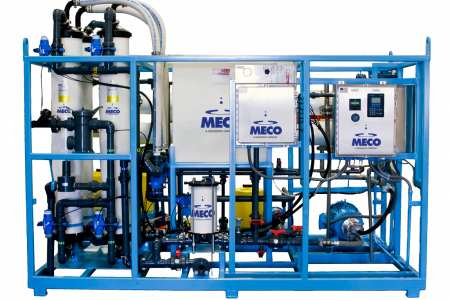
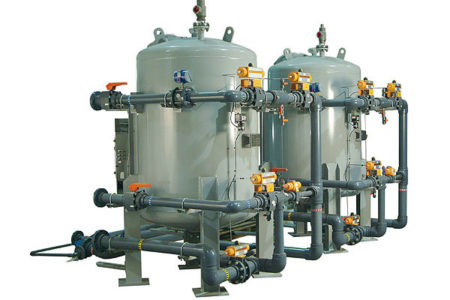
With MECO, you enjoy a wide range of choices in the application of the softening process to your water system. The choice of design -- co-current, counter current or packed bed -- as well as materials of construction, quantity and size will depend on a detailed feed water analysis, as well as factors related to integration, validation, operation and maintenance.


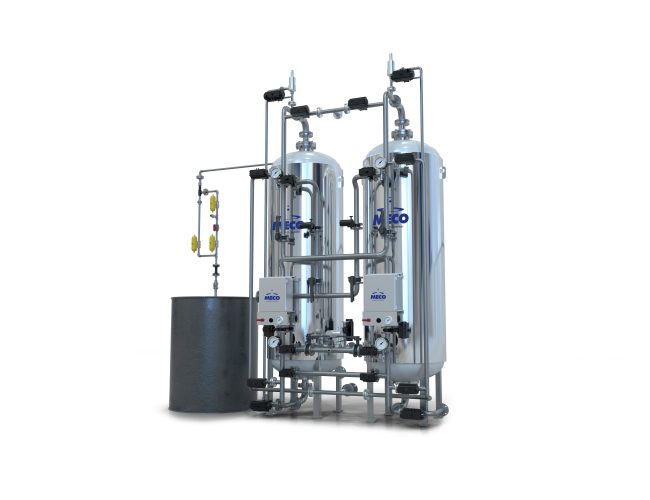
MECO Water Softeners are designed for the removal of hardness, ammonia or both. The softeners are designed based on your effluent water quality required and the feed water analysis. Softeners can be provided individually or as part of a total water treatment solution.

The control system for the water softener can be dedicated to the softener or part of a total system. Softener systems are designed specifically for your application using either fiberglass, PVC, lined carbon steel or stainless steel in the materials of construction.

In addition, each softener is equipped with the MASTERedge™ Package, a system of features that provides even greater value. You also benefit from the expert and responsive service delivered through MECO's MASTERsupport™ service capabilities.

Under-Drain/Internals

One of the most important aspects of any filter system is the design of the internals and the associated supports. On MECO filters you will find header lateral or hub radial distributors and collectors at the entrance and effluent of the vessel. The result is an efficient filter with a high degree of reliability and low maintenance.


Manifolded Valving & Piping Supports

A standard feature of MECO media filters, softeners and carbon filters is independent valving completely assembled, manifolded, supported and tested. As a result, you get a system that is highly reliable, easy to troubleshoot, maintain and install.


Stainless Steel Airlines

As part of the MASTERedge™ package on MECO pretreatment vessels, your system will be fitted with stainless steel airlines. While the plastic alternative is certainly easier to install, the stainless system is more robust and less susceptible to nicks and cracks resulting in improper valve operation.


Solenoid Panel

MECO filter vessels are completely preassembled and tested with all valves and air lines led to one central solenoid panel. You will find this system more organized, easier to troubleshoot and validate.

Softening is an ion exchange process used to remove ions from the water that contribute to alkaline scale formation, primarily calcium and magnesium. As water containing these ions passes through the softening resin bed, the ions are exchanged with sodium ions residing on the surface of the resin.

When no more sodium ions are left for this exchange process, the resin must be regenerated. Regeneration is accomplished with a brine solution of sufficient strength to cause an exchange between the sodium ions in the brine and the calcium and magnesium ions on the resin. Once regeneration is complete, the resin is ready to begin the softening cycle again.

All types of Ion Exchange Technology, co-current, counter-current and packed bed (upcore), can be used for water softening. The most economical way to produce the required effluent quality determines the choice of the system. The definition of the "most economical way" is not the same for all companies. Some consider the capital cost, others the operating cost of the system, as predominant. Consequently, a given set of requirements not always leads to the same choice of system. Generally, there is a compromise between the regenerant consumption and the unit size for all systems.

Most ion exchange softeners are co-current, meaning that the service flow and the regenerant flow will pass the IX unit in the same direction (downflow). It is the simplest, and the most reliable, process to operate. The hardness content in the bottom layers of the resin bed will still be considerable after the regeneration has been completed. This causes the reaction to partially reverse in the bottom layers of the bed and hardness leakage is the result. The required softened water quality will define the minimum regeneration level for a co-current softener (varies with the feed water composition). The production of very high quality softened water requires an extremely high regeneration level. The salt consumption per unit of softened water becomes prohibitive.

Counter-current regeneration is applied when the soft water quality requirements exceeds those that can reasonably be achieved with co-current regeneration. In counter-current units, the regenerant flow moves in the opposite direction as the service flow. The resin layers that are contacted last by the service water are those that have seen a large excess of regenerant and contain very little hardness ions. The partial reversal of the reaction, causing the leakage in a co-current unit, does no longer occur. Theoretically the leakage of a counter-current unit would be zero. Practically, leakage of 0.1 to 0.2% is achieved, almost independent of the regeneration level. During the upflow regeneration, the resin bed must not be disturbed. An extra (inactive) layer of resin must be added at the top of the unit. During brine injection, an extra flow comes from the top of the unit to keep the resin bed down. A counter-current unit always contains more resin then its co-current counterpart. It also must be kept in mind that saving salt by the use of low regeneration levels increases the resin volume (and the size) of the unit.

More recently, "Packed Bed" (Upcore) technology has entered the picture. Here, the ion exchange columns are almost completely filled with active resin. The 80-100% freeboard in the regular IX units, used to backwash and expand the resin bed for removal of suspended solids, is no longer present and the suspended solids are controlled by other means. Packed bed units also employ counter-current regeneration. The leakage levels are low but do not reach those obtainable by true counter-current units. The brine injection step of the regeneration cycle must be performed at high linear flow rate because the resin bed has to be lifted and kept compacted against the top collector of the unit. This usually necessitates higher regeneration levels and lower efficiency than those that can be used for a true counter-current unit.

The differences between the performance of the three softening technologies, operating under the same conditions regarding flow and influent water composition, is presented below. The best choice of the system to be used may be influenced by the composition of the influent water. For this reason, two calculations are given, the second set for water with much higher hardness and TDS.
 

Influent water A:

 Hardness: 85 ppm as CaCO3 (5 gr./USgal)

 TDS: 150 ppm as CaCO3

 System flow: 50 USgpm

 Time between regenerations: 12 hours.


Influent water B:

 Hardness: 250 ppm as CaCO3 (5 gr./USgal)

 TDS: 304 ppm as CaCO3

 System flow: 50 USgpm

 Time between regenerations: 12 hours.
 

General Comparison of Systems

As is shown on the table, the hardness of the feed water is very important for the equipment sizes. For feed water with low hardness, the equipment size is determined by the system flow and the run length follows from it. At higher influent hardness, the amount of chemical work becomes the determining factor. For a given performance, packed bed units are generally the smallest and the most efficient. Regular removal of suspended solids is necessary for all systems in order to maintain proper plug flow complication. The removal from packed bed units is the most difficult to handle in this respect.

Conventional Co-current Regeneration

The most common softener is the conventional co-current regeneration design. In a conventional softener, the vessel is only about half filled with resin to provide room for bed expansion during the backwash cycle. During the regeneration cycle, the brine flow is in the same direction as the service flow, namely down through the resin bed.
Operating Cycles

  • Service Cycle
  • Backwash Cycle
  • Regeneration Cycle
  • Rinse Cycle

Advantages

  • Simple design
  • Simple operation

Disadvantages

  • Hardness leakage
  • Regeneration efficiency

Conventional Counter-Current Regeneration

In a conventional softener, the vessel is only about half filled with resin to provide room for bed expansion during the backwash cycle. During the regeneration cycle, the brine flow is in the opposite direction (up) as the service flow (down).

Operating Cycles

  • Service Cycle
  • Backwash Cycle
  • Regeneration Cycle
  • Rinse Cycle

Advantages

  • Lower hardness leakage
  • Improved regeneration efficiency

Disadvantages

  • Design complexity
  • Operating complexity

Packed Bed Up-Flow, Counter-Current Regeneration (Upcore)

In a packed bed softener, the vessel is almost completely filled with resin. During the regeneration cycle, the brine flow is in the opposite direction (up) as the service flow (down).

Operating Cycles

  • Service Cycle
  • Compaction Cycle
  • Regeneration Cycle
  • Settling Cycle
  • Rinse Cycle

Advantages

  • Lower hardness leakage
  • Improved regeneration efficiency
  • Lower water usage for backwash / Regeneration
  • Short regeneration time
  • Compact size

Softener Comparison


 Influent Hardness: 85 ppm as CaCO3

 TDS: 139 ppm as CaCO3

 System flow: 50 USgpm (net)

 Time between regenerations: 12 hours. Two units, one on line


UNIT

CO-CURRENT

COUNTER-CURRENT

PACKED BED

Regeneration
water (average)

USgpm

1.0

1.2

0.6


Effluent hardness

ppm CaCO3

1.8

0.2

0.4


Regeneration
level 100% NaCl

Lbs/ft3

4.0

4.0

6.0


NaCl (100%) consumption

Lbs/1000USgal

1.21

1.21

1.20


Resin per unit

ft3

10.8

12.6

7.3


Vessel diameter

ft

2.0

2.0

1.5


Vessel straight side

ft

6.5

7.5

5.1


 Influent Hardness: 250 ppm as CaCO3

 TDS: 304 ppm as CaCO3

 System flow: 50 USgpm (net)

 Time between regenerations: 12 hours. Two units, one on line


UNIT

CO-CURRENT

COUNTER-CURRENT

PACKED BED

Regeneration
water (average)

USgpm

2.4

3.6

1.6


Effluent hardness

ppm CaCO3

3.5

0.2

0.4


Regeneration
level 100% NaCl

Lbs/ft3

6.0

4.0

6.0


NaCl (100%) consumption

Lbs/1000USgal

4.14

3.60

3.40


Resin per unit

ft3

24.8

37.4

20.8


Vessel diameter

ft

2.5

3.0

2.0


Vessel straight side

ft

9.0

10.0

7.6


Q: Why do I need to soften my feed water?

A: In the process of producing water for your facility, one or more of the treatment steps will concentrate the impurities in a waste or blowdown stream (such as, filtration systems or distillate systems). Calcium and magnesium could reach a concentration level where they will precipitate out as scale. Softening the water will remove the calcium and magnesium.

Q: Do I have to use Softeners in front of my RO unit?

A: It depends on your water supply. At certain levels of hardness you can use an anti-scalant as your water treatment to prevent scale formation in the RO unit. RO projections can be used to evaluate the effectiveness of anti-scalant injection for your feed water analysis.

The MECO Pretreatment Vessel MASTERedge Package™

Dynapore Mesh screen

The under-drain system has a Dynapore Mesh screen completely over each lateral component. This screen does not allow media to flow out of the vessel to the downstream components; thus removing the requirement for filter cartridges after pretreatment vessels.

Bed Expansion

Freeboard design exceeds the bed expansion during the backwash process, which eliminates the loss of media.

Sanitization Options

Designed for sanitization with clean steam, hot water or the patented sanitization from a MECO Vapor Compression Still.

Solenoid Panel

A solenoid panel is located on each vessel for one central air line connection. Stainless Steel Airlines connected to each individual valve.

Standout features include:

  • Galvanized rigid conduit
  • Stainless Steel Airlines
  • Conservative flux rates
  • Mirror finish stainless steel cladding on all sanitizable designs

Anytime. Anywhere.

  • 24 hours, 7 days a week access to effectively manage your water system.

Real Time Access to:

  • Purchase spare parts online
  • Track status of outstanding orders
  • Review shipping information
  • Review invoice/payment history
  • Review online maintenance records
  • Request technical information
  • Online electronic manuals
  • Remote system monitoring capabilities

  MECO understands the importance of providing our customers with the parts and services required to maintain systems operating at optimum capacity. Our online service center - MECO MASTERsupport™ is a good example of that. It enables you to monitor your system remotely, place orders, access service records and view your system's manuals when it's convenient for you. Anytime. Anywhere.

With a simple point and click, our entire parts inventory is available to you. Through the online service center, you also get real-time access to invoices, orders, shipping status, system manuals and service trip reports. Everything you need to know to effectively manage and maintain your treatment plant is right at your fingertips.

It's another example of MECO's commitment to providing the highest quality spare parts and cost effective support throughout the life-cycle of the product.

» Launch MASTERsupport™ Online

Headquarters   12505 Reed Road, Suite 100   •   Sugar Land, TX 77478   •   phone: 281.276.7600   •   tollfree: 800.421.1798   •   fax: 281.313.0643
Copyright ©2012 MECO Incorporated. All rights reserved.