





Water for Life Sciences and Healthcare

High-purity water is a foundational utility across life sciences and healthcare. Whether supporting pharmaceutical manufacturing, research and analytical laboratories, or healthcare facilities, water systems directly influence regulatory compliance, product integrity, analytical accuracy, equipment performance, and patient safety.
There is no single regulatory definition for “medical-grade water.” In practice, water quality is defined by application-specific standards, each with its own requirements, terminology, and validation expectations. What unites all of these environments is the need for controlled, consistent, and verifiable water quality delivered through well-engineered systems.
High-purity water is generally applied across three primary domains:
- Pharmaceutical manufacturing
Water quality is defined by pharmacopeial standards such as USP, EP, JP, and CP, including Purified Water (PW) and Water for Injection (WFI). - Research, analytical, and academic environments
Water quality is defined by laboratory standards such as ASTM Types I, II, III, and IV and Clinical Laboratory Reagent Water (CLRW). These users include biotech R&D, QC laboratories, and academic institutions. - Healthcare facilities
Water quality is defined by requirements for the processing of medical devices and clinical diagnostics, including standards such as AAMI ST108 and CLRW. These systems support sterile processing departments (SPD), clinical laboratories, and patient-care environments.
While each domain uses different language and regulatory frameworks, all rely on validated water systems that deliver reliable, controlled performance.
What Is High-Purity Water?
High-purity water refers to water that has been treated to meet strict limits for:
-
- Conductivity
-
- Total Organic Carbon (TOC)
-
- Microbial content
-
- Endotoxins (where applicable)
The exact limits and testing methods depend on the governing standard. High-purity water is not a single grade, but a range of water qualities engineered to match the sensitivity of each application.
Applications Across Life Sciences and Healthcare
High-purity water supports critical functions across all three domains:
Pharmaceutical manufacturing
-
- Drug formulation and compounding
-
- Final rinsing of product-contact equipment
-
- Biologics and cell culture manufacturing
-
- Sterile and aseptic processing
Research, analytical, and academic
-
- Chromatography (HPLC, LC-MS)
-
- PCR, sequencing, and molecular biology
-
- Reagent preparation
-
- Quality control testing
Healthcare
-
- Processing of medical devices in sterile processing departments
-
- Washer-disinfectors and sterilization equipment
-
- Clinical diagnostics and laboratory testing
-
- Patient-care support systems
In each case, water quality directly impacts outcomes: product safety, analytical reliability, equipment longevity, and patient protection.
Pharmaceutical Water Classifications

Purified Water (PW)
Purified Water is defined by pharmacopeial limits for conductivity, TOC, and microbial content. It is commonly used for:
-
- Equipment cleaning and rinsing
-
- Preparation of non-injectable products
-
- Feedwater for WFI systems
PW systems typically use combinations of:
-
- Reverse osmosis
-
- Deionization or electrodeionization
-
- Filtration and UV oxidation
Water for Injection (WFI)
WFI represents the highest grade of pharmaceutical water. In addition to PW requirements, WFI must meet strict limits for endotoxins and microbial contamination.
It is used for:
-
- Injectable drug products
-
- Final rinse of product-contact equipment
-
- Biologics and sterile manufacturing
Under the Chinese Pharmacopeia (CP): “Water for Injection is water prepared by distillation… or may be prepared by a purification process equivalent to distillation.”
This reflects the principle that WFI quality is defined by validated performance, not solely by the purification method itself.
Laboratory and Clinical Water Standards
Beyond pharmacopeial grades, high-purity water systems may be designed to meet:
-
- ASTM Type I, II, III, and IV
-
- Clinical Laboratory Reagent Water (CLRW)
-
- CAP and CLSI guidance
-
- Low-TOC requirements for LC, MS, and HPLC
-
- Nuclease- and endotoxin-controlled water for molecular biology
These classifications support analytical accuracy and reproducibility.
Healthcare Water Requirements
In healthcare environments, water quality directly affects medical device processing outcomes. Standards such as AAMI ST108 define water requirements for cleaning, disinfection, and sterilization, recognizing that:
-
- Poor water quality can reduce cleaning effectiveness
-
- Dissolved salts and organics can damage devices
-
- Microbial contamination can increase patient risk
ST108 emphasizes maintaining water systems in a controlled state through:
-
- Defined water quality categories
-
- Risk-based design
-
- Monitoring and maintenance
-
- Distribution system integrity
In this context, water is not simply a utility—it is a patient safety component.
Core Treatment Technologies
High-purity water systems rely on a multi-barrier approach. Each technology targets specific contaminant classes and contributes to stability and redundancy.
-
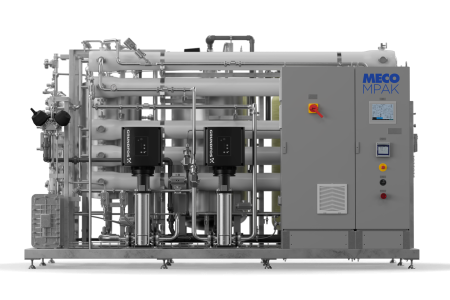
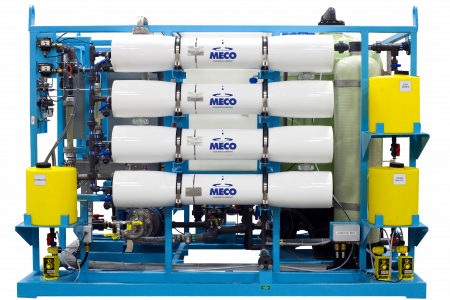
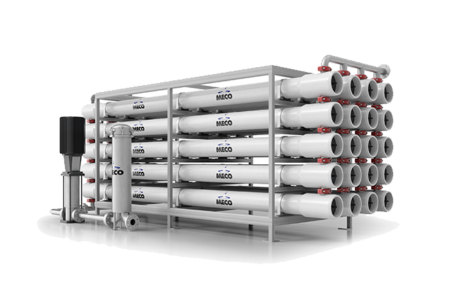
- Reverse Osmosis (RO) removes dissolved salts, organic compounds, microorganisms, and particulates. RO forms the foundation of most high-purity water systems.
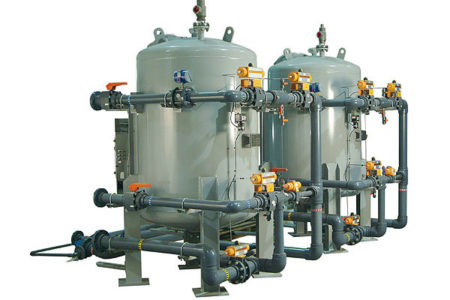
- RO + Deionization (DI) traditional configuration using mixed-bed ion exchange. Effective but requires chemical regeneration.
- RO + Electrodeionization (EDI) uses electrical current and ion-exchange membranes to remove residual ions. Provides continuous ionic purification without chemical regeneration and supports automation.
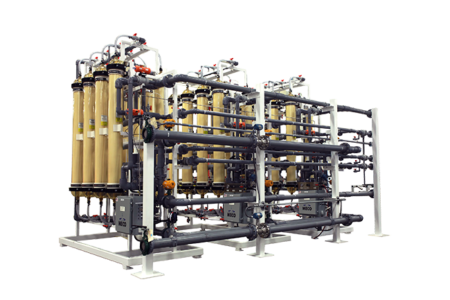
- Ultrafiltration (UF) provides endotoxin reduction, additional microbial protection, final polishing prior to storage or distribution.
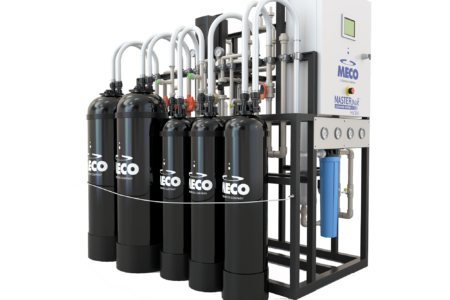
- Carbon Filtration removes chlorine, chloramines, and organic compounds that can damage downstream systems.
- Water Softeners remove hardness that contributes to scale formation and membrane fouling.
Storage and Distribution
High-purity water is stored and distributed through sanitary, pharmaceutical-grade systems designed to preserve quality from generation to point of use. Water quality is maintained using validated microbial control strategies, selected based on system design, regulatory expectations, and facility validation philosophy. These strategies may include:
-
- Ozone
-
- Hot water sanitization
-
- Chemical sanitization
Where residual disinfectants are used, neutralization methods such as UV degradation are applied before point-of-use delivery.
Key Attributes of High-Purity Water Systems
-
- Reduced energy intensity through electrically driven purification
-
- Sustainability alignment via lower carbon intensity and renewable energy compatibility
-
- Compact physical footprint supporting modular and retrofit designs
-
- Operational responsiveness for variable demand profiles
-
- Reduced thermal dependency, lowering system complexity and safety risk
Design Considerations
Effective high-purity water system design requires evaluation of:
Feedwater characteristics
-
- Ionic composition
-
- Organic content
-
- Microbial profile
-
- Seasonal variability
System capacity
-
- Peak demand
-
- Daily production volume
-
- Storage requirements
Microbial control strategy
-
- Selected based on validation philosophy
-
- Compatible with automation and monitoring
Distribution system design
-
- Sanitary, pharmaceutical-grade piping
-
- Continuous circulation
-
- Dead-leg elimination
-
- Proper slope and drainability
Monitoring and validation
-
- Conductivity
-
- TOC
-
- Microbial testing
-
- Endotoxin control
-
- Data integrity and documentation
A Unified View
Water for life sciences and healthcare is governed by different standards, but unified by a single requirement: reliable, validated performance.
By applying multi-barrier treatment strategies, sanitary system design, and application-specific validation frameworks, organizations can support:
- Regulatory compliance
- Product and patient safety
- Analytical accuracy
- Long-term operational reliability
This integrated approach reflects water’s role as a truly critical utility across pharmaceutical manufacturing, research environments, and healthcare facilities. Contact our team today to learn more about how we can support your critical operations.