MECO - A worldwide leader in water purification


Multiple Effect Stills

Why Choose MECO? There are Multiple Reasons.

MECO has been building Multiple Effect Stills for over 50 years. Our state of the art controls and MECO's MASTERsupport™ service capabilities are unmatched in the industry. Combining these features with our experience and ability to efficiently build these stills yields a "best value" product from both a technical and commercial perspective.


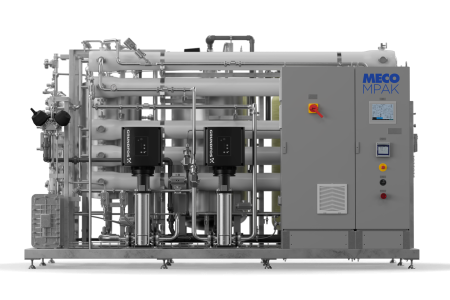
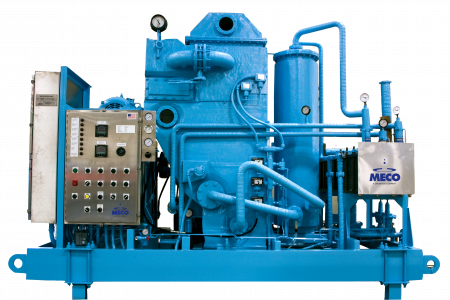
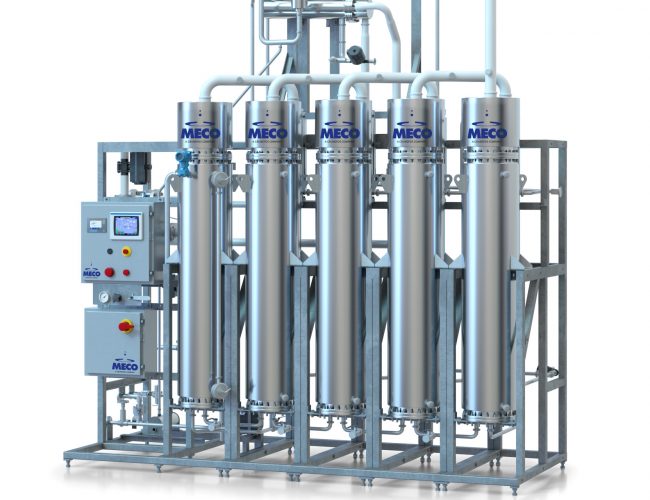
MECO Multiple Effect Stills (MEF) come equipped with a distillate pump for unlimited distribution, a condenser mounted low for ease of maintenance and the controls you need for stable operation. It's all within our MASTERedge Package™, a system that provides even greater value. You also benefit from the expert and responsive service delivered through MECO's MASTERsupport™ service capabilities.

Our MEF distillers are designed to produce Water For Injection (WFI) in accordance with the U.S. Pharmocopoeia. In addition, the MECO MEF Stills meet or exceed cGMP/USP industry standards including sanitary construction features such as double tubesheets on the first effect and condenser exchangers, sloped piping and low point drains, minimum deadlegs, and sanitary connections.

State of the Art Controls

Using PID loops with transmitters and control valves on the process utilities enables the MECO multiple effect still to operate in a stable and uninterrupted manner regardless of external influences.

Rigid Conduit & Stainless Steel Airlines

Rigid conduit for cabling and stainless airlines are provided as part of the MASTERedge Package™ on MECO multiple effect stills. While the alternative of cable trays with exposed cabling and plastic air lines are certainly easier to install, MECO's system is more robust and less susceptible to damage creating problematic operation.

Condenser

MECO Multiple Effect Stills come with a condenser mounted at floor level for easy access and maintenance. The large surface area provides WFI at 180 deg F without the need for an aftercooler or chilled water. MECO condensers are designed to operate at 5 psig to deliver WFI to a nearby storage tank.

Control systems are taken for granted until a utility fluctuation within the plant has impacted your critical utility. Fluctuations in feed water pressure, plant steam pressure, etc. can have an impact on the quantity and sometimes quality of the water produced. The MECO MASTERedge Package™ incorporates the most versatile and accurate process parameter control system into the MECO Multiple Effect Still.

Process Control Basics

In the majority of process systems, there are one or more process parameters that must be maintained. The purpose of a process control scheme is to maintain a desired parameter regardless of any external influence. Process parameters in typical water systems include temperature, pressure and level. Since water systems generally utilize one or more plant utilities, it is often fluctuations in the parameters of these utilities that a process system must address. Three general schemes may be utilized to address the utility fluctuations - isolation, regulation and accommodation.


Isolate - Break Tank / Pump
One possible application of the isolation scheme is for feed water flow control in a still or steam generator. In this application, fluctuation in feed water pressure is negated by the use of a break tank. Once the feed water is in the break tank, the pressure is atmospheric regardless of the line pressure feeding the tank. The water in the tank is then supplied to the unit by a feed pump pumping against a manual feed control valve or an orifice.


Regulate - Self-Contained Regulator
The regulate scheme may be used to regulate the pressure of feed water or plant steam to a still or steam generator. The regulator can be set to maintain the pressure of either of these utilities. Regulators may be a part of the utility piping external to the still or generator, or they may be integral to the unit piping. Since regulators do not offer a "closed" position, an additional automated valve is required in the downstream line. The regulate scheme only regulates the utility parameter which is not necessarily the critical parameter that must be maintained.


Accommodate - PID Loops
The accommodate scheme is similar to regulator scheme with one major exception - the utility is regulated, as necessary, to maintain the desired critical parameter.

For this scheme three primary components are required:

  • Sensor to measure and transmit a signal representative of the critical parameter
  • Controller to compare the actual values of the parameter to the desired value uses the difference between the two to produce an output signal to eliminate the difference
  • Final control element to control the utility parameter on the output signal from the controller


These elements are usually integrated into the still or generator with the unit control system handling the controller function. This scheme provides the most accurate control of the measured parameter under all conditions.

The Proportional, Integral, and Derivative constants in the controller logic are used to calculate what the output should be relative to the measured error.

Proportional - The controllers output is proportional to the error or a change in measurement.

Integral - The controllers output is proportional to the amount of time the error is present.

Derivative - The controllers output is calculated by the rate of change of the measurement with time.

MECO MASTERedge™ Feed Water Level Control

The feed water level in the MECO Multiple Effect Still is maintained with a PID control loop. The proper feed water level is maintained in the evaporator even under fluctuating feed water pressure conditions. The PID control loop senses the actual level and adjusts the flow rate of feed water up or down to maintain the level at the desired point. Integrated into the still, this system provides precise control without the use of space-consuming external break tank / feed pump systems or external regulators. All loop parameters can be viewed from the unit's operator interface.

The level transmitter (LT) senses the feed water level in the evaporator and transmits a corresponding 4-20 ma signal to the unit's PLC-based control system. The PLC feed water level logic (LIC) monitors this input signal and determines the error between the actual level in the evaporator and the desired level. If the actual level is higher than the desired level, an output signal from the PLC will close the feed water control valve to reduce the feed water flowrate to the evaporator. If the actual level is lower than the desired level, an output signal from the PLC will open the feed water control valve to increase the feed water flowrate to the evaporator. The output signal from the PLC will take into consideration the magnitude of the error, the length of time that the error has existed, and the rate at which the error is changing to provide the most accurate control possible.

The 4-20 ma output signal from the PLC is sent to the current to pressure transducer (LY), which converts the electrical signal to a corresponding 3-15 psig pneumatic signal. The pneumatic signal is sensed by the feed water control valve positioner. The positioner also senses the position of the valve stem and maintains a valve position corresponding to the signal from the PLC, regardless of line pressure forces acting on the valve.
 

MECO MASTERedge™ Condenser Level Control

The distillate level in the MECO Multiple Effect Still is also maintained with a PID control loop. The proper distillate level is maintained in the condenser under all conditions. The PID control loop senses the actual level and adjusts the flow rate of distillate up or down to maintain the level at the desired point. Integrated into the still, this system provides precise level control providing a pressurized distillate output rather than an atmospheric pressure, gravity driven stream. All loop parameters can be viewed from the unit's operator interface.

The level transmitter (LT) senses the distillate level in the condenser and transmits a corresponding 4-20 ma signal to the unit's PLC-based control system. The PLC distillate level logic (LIC) monitors this input signal and determines the error between the actual level in the condenser and the desired level. If the actual level is higher than the desired level, an output signal from the PLC will open the distillate control valve to increase the distillate flowrate from the condenser. If the actual level is lower than the desired level, an output signal from the PLC will close the distillate control valve to decrease the distillate flowrate from the condenser. The output signal from the PLC will take into consideration the magnitude of the error, the length of time that the error has existed, and the rate at which the error is changing to provide the most accurate control possible.

The 4-20 ma output signal from the PLC is sent to the current to pressure transducer (LY), which converts the electrical signal to a corresponding 3-15 psig pneumatic signal. The pneumatic signal is sensed by the distillate control valve positioner. The positioner also senses the position of the valve stem and maintains a valve position corresponding to the signal from the PLC, regardless of line pressure forces acting on the valve.
 

MECO MASTERedge™ Distillate Temperature Control

The distillate temperature from the MECO Multiple Effect Still is maintained with a PID control loop. The proper distillate temperature existing the still is maintained under all conditions. The PID control loop senses the actual temperature and adjusts the flow rate of cooling water up or down to maintain the temperature at the desired point. The loop parameters can be viewed from the unit's operator interface.

The temperature transmitter (TT) senses the distillate temperature exiting the condenser and transmits a corresponding 4-20 ma signal to the unit's PLC-based control system. The PLC distillate temperature logic (TIC) monitors this input signal and determines the error between the actual temperature exiting the condenser and the desired temperature. If the actual temperature is higher than the desired temperature, an output signal from the PLC will open the cooling water control valve to increase the cooling flowrate through the condenser. If the actual temperature is lower than the desired temperature, an output signal from the PLC will close the cooling water control valve to decrease the cooling water flowrate through the condenser. The output signal from the PLC will take into consideration the magnitude of the error, the length of time that the error has existed, and the rate at which the error is changing to provide the most accurate control possible.

The 4-20 ma output signal from the PLC is sent to the current to pressure transducer (TY), which converts the electrical signal to a corresponding 3-15 psig pneumatic signal. The pneumatic signal is sensed by the cooling water control valve positioner. The positioner also senses the position of the valve stem and maintains a valve position corresponding to the signal from the PLC, regardless of line pressure forces acting on the valve.
 

MECO MASTERedge™ Plant Steam Pressure Control (for pure steam option)

The pressure of the pure steam produced by the MECO Multiple Effect Still is maintained with a PID control loop. The proper pure steam pressure is maintained in the evaporator under all conditions. The PID control loop senses the actual pressure and adjusts the flow rate of plant steam up or down to maintain the pressure at the desired point. Integrated into the still, this system provides precise pressure control of the pure steam over the full range of pure steam demand. All loop parameters can be viewed from the unit's operator interface.

The pressure transmitter (PT) senses the pure steam pressure in the evaporator and transmits a corresponding 4-20 ma signal to the unit's PLC-based control system. The PLC pure steam pressure logic (PIC) monitors this input signal and determines the error between the actual pressure in the evaporator and the desired pressure. If the actual pressure is higher than the desired pressure, an output signal from the PLC will close the plant steam control valve to descrease the plant steam flowrate to the evaporator. If the actual pressure is lower than the desired pressure, an output signal from the PLC will open the plant steam control valve to increase the plant steam flowrate to the evaporator. The output signal from the PLC will take into consideration the magnitude of the error, the length of time that the error has existed, and the rate at which the error is changing to provide the most accurate control possible.

The 4-20 ma output signal from the PLC is sent to the current to pressure transducer (PY), which converts the electrical signal to a corresponding 3-15 psig pneumatic signal. The pneumatic signal is sensed by the plant steam control valve.

Q: What are the pretreatment needs of MEF?

Multi-Effect Stills require the removal of chlorine, ammonia, hardness and other scales. As a minimum, a single pass RO is required. More typical is a two pass RO and possible a DI polisher. All of these systems will require chlorine removal through a carbon filter or bisulfite injection as well as hardness removal softeners or anti-scalant injection.

Q: How does MEF differ from VC?

A: It differs by the following criteria:

  • Thermodynamic process
  • Operating parameters (temperature and pressure)
  • Utilities
  • Feedwater quality / pretreatment
  • Maintenance
  • Corrosion and scaling characteristics
  • Dimensional differences

Q: How does the water quality of MEF compare to that of VC?

A: Both MEF and VC produce water that meets the WFI requirements in the U.S. Pharmacopoeia.

Q: Is the water repeatedly distilled in an MEF from one effect to the next?

A: The water is not repeatedly distilled. Each effect produces a portion of the over all output.

Q: Will I need to consider a distillate and feed water pump on an MEF unit?

A: Most MEF designs use gravity to flow distillate from the condenser to the storage tank. MECO's standard unit can supply 5 psig at the edge of the skid for supply pressure to a tank. If this is not sufficient we offer a distillate pump option which can provide however much pressure is required. Most of the time you will need to provide a feed water pump. The feed water pressure requirements vary from 80-100 psig depending on the operating conditions.

The MECO Multiple Effect MASTERedge Package™

3 X PID Control Loops

Control systems are sometimes taken for granted until a utility fluctuation within the plant has impacted your criticalutility. Fluctuations in feedwater pressure, WFI temperature and condenser level can all have a direct impact on theconsistency and quality of the water produced. With 3 PID loop controls, your plant will operate in the most stablemanner regardless of external influences.

Hot Standby Operation

MECO’s control system allows for automatic hot standby operation with instantaneous start up. Delayed start-ups due toheating and stabilization are a thing of the past.

Floor Level Condenser

Condensers are often mounted up high so that the distilled water can gravity feed to a nearby storage tank. This is doneprimarily to give a bit of distillate pressure using gravity. While this is an inexpensive design, the distillate pressure isvery low and cannot fill a tank higher than the level of the condenser without the addition of a pump. MECO Multiple Effectunits have the condenser mounted down low. MECO has designed its condenser to allow a distillate head pressure greaterthan that of a high mount condenser design without the use of a distillate pump. This allows the unit to fill a tank to alevel much higher than the height of the condenser. An added benefit to the lower condenser is the ease of accessibilityfor any maintenance and a greater range of operation without the use of a pump.

Natural Circulation Evaporator

Most people don’t consider the configuration of the heat transfer surface until there is a problem with the pretreatmentsystem resulting in scale formation. MECO’s natural circulation evaporator ensures an even distribution of raw waterminimizing scale formation, any scale formation that does occur is evenly distributed as well as the subsequent cleaningoperation. Distribution plates and spray nozzles are a thing of the past.

Straight Annealed Tubes

By using straight tubes that have been stress relieved through annealing, we are able to get a superior surface finish aswell as inspect and remove any single tube should the need arise. U – Tubes are less expensive, but inherently stressedwith the associated surface finish disruption. If problems do arise, the entire U Tube bundle may require removal or replacement.

Large Surface Area Condenser

By enlarging our condenser surface area, MECO MEF plants do not need chilled water.

Standout Features Include:

  • Conformance to cGMP & ISPE/FDA guides for Water and Steam Systems
  • Forged Valving in distilled water service meets the latest standards of the cGMP & ISPE/FDA guidelines on water andsteam systems
  • A low ferrite distillate pump (less than 5%) machined from 316SS bar stock (if so provided)
  • Cabling in galvanized rigid conduit protects your electrical and instrument cables
  • Stainless steel airlines properly manifolded provide the highest level of integrity for your instruments and controls
  • Mirror finish cladding in stainless steel provides the highest quality appearance we have all come to expect in today’senvironment

Anytime. Anywhere.

  • 24 hours, 7 days a week access to effectively manage your water system.

Real Time Access to:

  • Purchase spare parts online
  • Track status of outstanding orders
  • Review shipping information
  • Review invoice/payment history
  • Review online maintenance records
  • Request technical information
  • Online electronic manuals
  • Remote system monitoring capabilities

  MECO understands the importance of providing our customers with the parts and services required to maintain systems operating at optimum capacity. Our online service center - MECO MASTERsupport™ is a good example of that. It enables you to monitor your system remotely, place orders, access service records and view your system's manuals when it's convenient for you. Anytime. Anywhere.

With a simple point and click, our entire parts inventory is available to you. Through the online service center, you also get real-time access to invoices, orders, shipping status, system manuals and service trip reports. Everything you need to know to effectively manage and maintain your treatment plant is right at your fingertips.

It's another example of MECO's commitment to providing the highest quality spare parts and cost effective support throughout the life-cycle of the product.

» Launch MASTERsupport™ Online

Headquarters   12505 Reed Road, Suite 100   •   Sugar Land, TX 77478   •   phone: 281.276.7600   •   tollfree: 800.421.1798   •   fax: 281.313.0643
Copyright ©2012 MECO Incorporated. All rights reserved.