





Why Pharmaceutical Manufacturers Are Looking for More Than Individual Equipment Suppliers

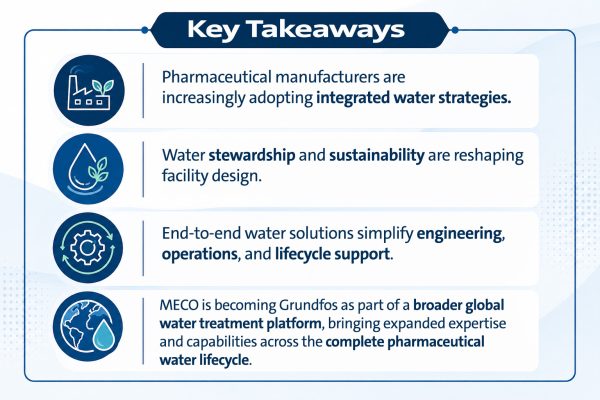
As pharmaceutical manufacturing evolves, facilities are looking beyond individual equipment toward integrated water solutions that improve efficiency, sustainability, resilience, and long-term performance. This evolution is changing not only how manufacturers approach water, but also what they expect from the partners who support them.
Pharmaceutical manufacturing has always depended on water. Today, however, water is becoming much more than a utility – it is increasingly viewed as a strategic resource that directly impacts production continuity, sustainability objectives, operational efficiency, and long-term business resilience.
As pharmaceutical manufacturing continues to grow globally, facilities are facing increasing pressure to reduce water consumption, improve resource efficiency, meet evolving environmental expectations, and ensure a reliable supply of critical utilities. At the same time, many organizations are establishing ambitious water stewardship and sustainability goals that extend well beyond regulatory compliance. Water scarcity concerns, climate-related disruptions, and increasing competition for freshwater resources are driving pharmaceutical manufacturers to think differently about how water is managed across their operations.
This shift is changing how pharmaceutical manufacturers evaluate their water infrastructure and why many are increasingly looking beyond individual equipment suppliers toward integrated solution partners.
The Challenge with Traditional Utility Procurement
Historically, pharmaceutical facilities have sourced water treatment systems, pumps, instrumentation, controls, storage systems, and service support from multiple suppliers.
While each vendor may provide expertise within a specific area, facility owners and engineering teams are often responsible for coordinating the overall system. Engineering firms must integrate technologies from numerous vendors. Procurement teams manage multiple supplier relationships. Operations personnel often rely on separate service providers, spare parts inventories, and support structures throughout the life of the facility.
As facilities become larger, more sophisticated, and increasingly focused on operational efficiency, many organizations are finding that optimizing individual components is no longer enough. The challenge is no longer selecting the best equipment – it is ensuring every system works together to achieve broader operational goals.
Why Water Has Become a Strategic Resource in Pharmaceutical Manufacturing
Across the pharmaceutical industry, water is increasingly being recognized as a business-critical resource.
Water availability can directly impact manufacturing capacity, operational continuity, and ultimately the reliable supply of medicines. As pharmaceutical production expands globally, water has become a resource risk in many regions where freshwater availability cannot be guaranteed long-term.
At the same time, regulatory frameworks are evolving to encourage greater water efficiency, water reuse, and circularity. Governments and industry organizations are placing increased emphasis on reducing water withdrawals, minimizing wastewater generation, and improving resource efficiency throughout industrial operations.
As a result, conversations that once focused solely on generating pharmaceutical-grade water are expanding to include:
- Water stewardship
- Water circularity and reuse
- Utility optimization
- Energy efficiency
- Wastewater reduction
- Sustainability initiatives
- Operational resilience
- Lifecycle performance
These priorities require a broader perspective than any single technology can provide.
The Rise of Water Stewardship in Pharmaceutical Manufacturing
Leading pharmaceutical manufacturers are increasingly incorporating water stewardship into their long-term sustainability strategies.
Organizations throughout the industry have established measurable goals related to water consumption, wastewater reduction, water reuse, and watershed protection. These initiatives are being driven not only by environmental commitments but also by the recognition that resilient water infrastructure is essential to future manufacturing operations. Because industrial facilities, communities, energy producers, and other water users often depend on the same watersheds, reducing water demand and protecting shared water resources is becoming increasingly important to strengthen resilience and help avoid future water shortages or competition for finite supplies.
Water stewardship goes beyond reducing consumption. It focuses on understanding how water moves throughout a facility, identifying opportunities to recover and reuse valuable resources, and optimizing the entire water lifecycle to maximize efficiency while maintaining product quality and regulatory compliance.
For pharmaceutical manufacturers, this means evaluating water systems as interconnected assets rather than isolated technologies.
Optimizing the Entire Water Lifecycle
The greatest opportunities for improvement often exist between systems rather than within them.
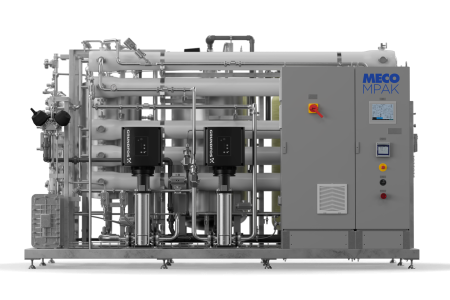
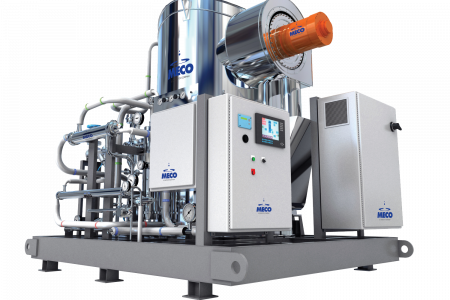
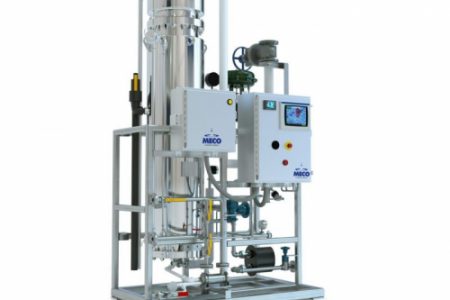
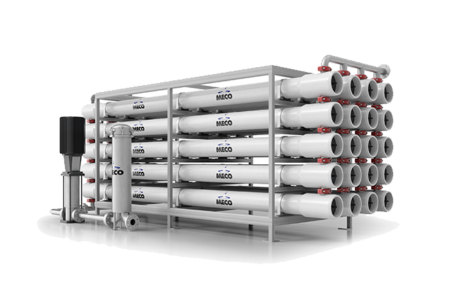
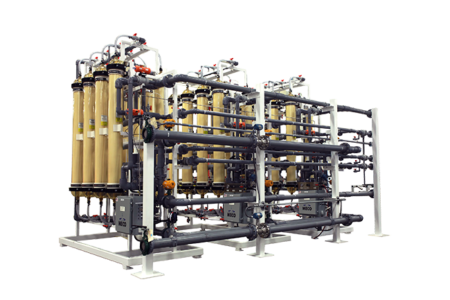
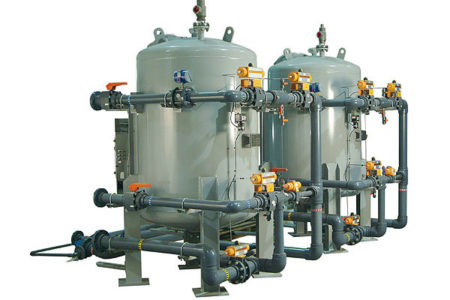
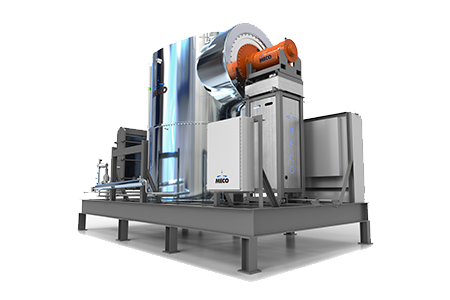
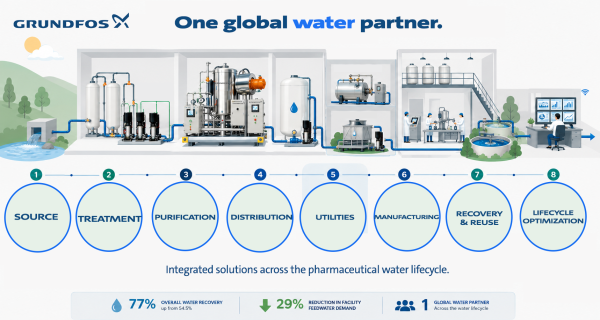
A modern pharmaceutical utility infrastructure is a connected ecosystem consisting of pretreatment technologies, reverse osmosis systems, water softening, storage and distribution systems, Water for Injection (WFI) generation, pure steam generation, pumping systems, monitoring technologies, controls, and water recovery processes.
When evaluated as a complete system, organizations can often identify opportunities to recover water, reduce waste streams, improve utility performance, and lower operating costs.
In one pharmaceutical water recovery evaluation, a system-level approach increased overall recovery from 54.5% to 77% while reducing facility feedwater demand by 29% and water sent to drain by 64%. Rather than focusing on a single process step, improvements were achieved by evaluating multiple utility streams and identifying opportunities for water recovery and reuse throughout the broader water infrastructure.
This type of optimization highlights an important shift occurring across the industry: manufacturers are increasingly looking at how systems interact with one another instead of evaluating technologies independently.
Why Pharmaceutical Manufacturers Are Choosing Integrated Water Solutions
As pharmaceutical manufacturers and engineering firms adopt a more holistic view of water management, the value of integrated solution providers becomes increasingly apparent.
An end-to-end approach can help simplify project execution while creating opportunities for greater system optimization across the facility lifecycle.
Potential benefits include:
- Coordinated engineering and design
- Reduced supplier interfaces
- Improved utility integration
- Enhanced water recovery opportunities
- Streamlined project execution
- Consistent service and support
- Greater operational visibility
- Improved sustainability performance
- Support for water stewardship initiatives
- Greater watershed protection
Most importantly, integrated partners are often able to evaluate how decisions made in one area of the facility affect performance elsewhere in the system.
Rather than focusing solely on water generation, integrated solution partners can help customers optimize the entire pharmaceutical water ecosystem.
Why MECO Is Becoming Grundfos
MECO was acquired by Grundfos in November 2021, bringing together MECO’s decades of expertise in pharmaceutical water purification with Grundfos’ global leadership in water and pumping solutions.
Since then, the pharmaceutical industry has continued to evolve toward a more integrated approach to water management. Manufacturers are increasingly looking beyond individual technologies to consider how water treatment, pumping, controls, monitoring, water reuse, and lifecycle support can work together to improve efficiency, resilience, and sustainability across their operations.
At the same time, Grundfos has continued to expand its water treatment capabilities globally. MECO is now part of Grundfos’ growing global network of water treatment expertise, bringing together specialized technologies and capabilities to address the entire water lifecycle. This network includes companies such as Water Works, Newterra, Grundfos Water Treatment Europe (formerly known as Eurowater, Culligan’s former European commercial and industrial water treatment business), and EUWA, each contributing expertise across different water treatment applications and industries.
Together, these capabilities are helping Grundfos evolve beyond individual equipment and technologies toward a more complete water solutions offering—from incoming water and treatment through process applications, water recovery and reuse, wastewater treatment, and lifecycle support.
For MECO and our pharmaceutical customers, becoming Grundfos is the next step in that journey. While our name is evolving, our commitment to innovation, engineering excellence, product quality, world-class service, and customer partnership remains unchanged.
Ready to Take a More Integrated Approach to Pharmaceutical Water?
Whether you’re designing a new facility, expanding production, or looking for opportunities to improve water efficiency across an existing operation, our team can help you evaluate the complete water lifecycle.
Connect with our pharmaceutical water experts to discuss your next project and discover what’s possible with an integrated water solutions approach. Contact the water experts today.